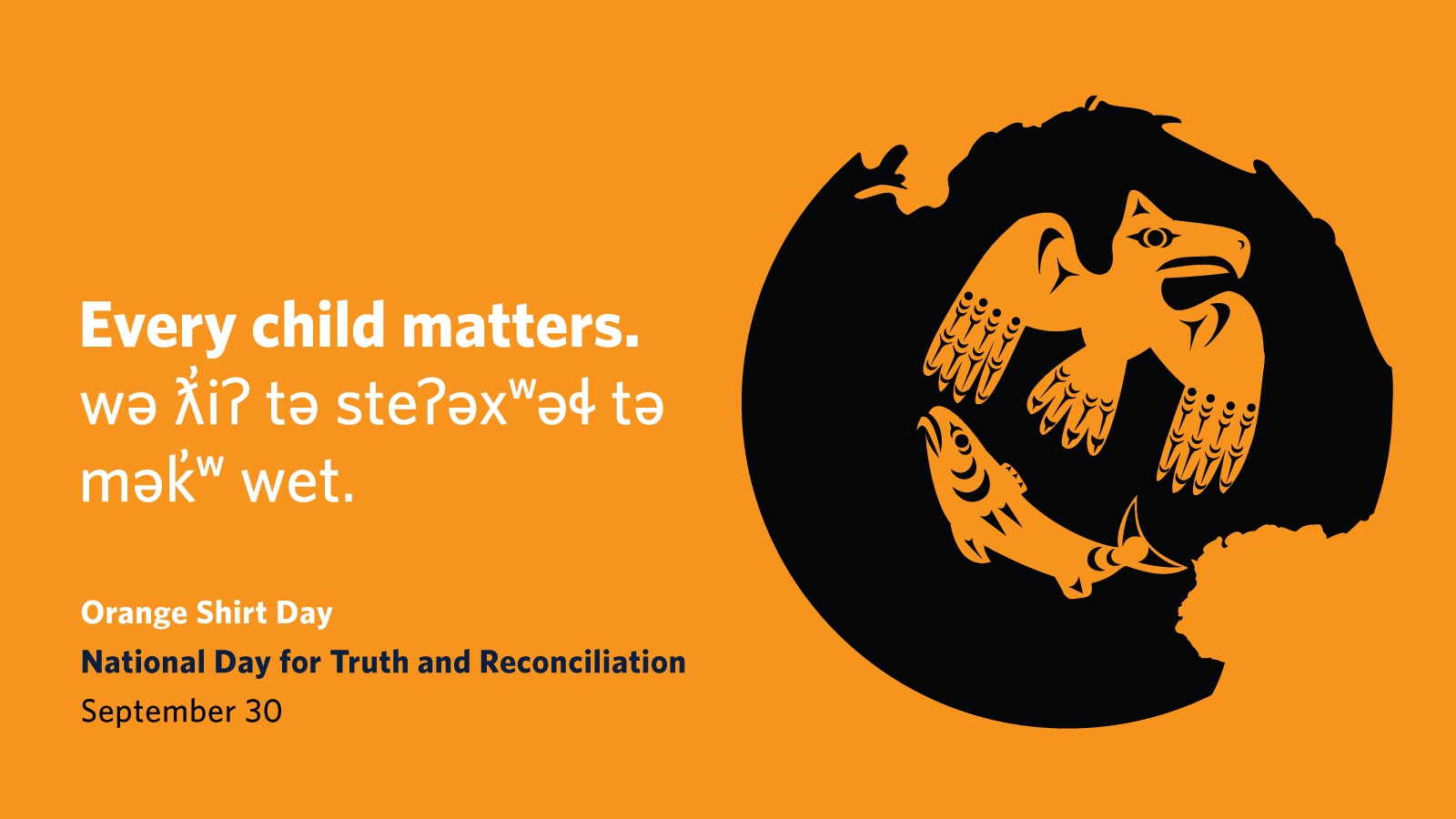
The Government of Canada has designated September 30 as the National Day for Truth and Reconciliation. This National commemoration is designated as an opportunity to honour residential school survivors, their families, and communities, as well as acknowledging that the history and legacy of residential schools remain a vital component of the reconciliation process. This action is a response to the Truth and Reconciliation Commission’s Call to Action #80 and calls the nation to pause and observe the history and legacy of the Indian Residential School system in Canada. For many, it will be a day of remembrance and mourning; for others, it will be a time to spread truth and awareness by simply wearing an orange shirt. Phyllis Webstad, a former student of St. Joseph’s Residential School in Williams Lake, founded Orange Shirt Day. Phyllis is a member of the Stswecem’c Xgat’tem First Nation and was sent to St. Joseph’s in 1973. Her grandmother sent Phyllis to St. Joseph’s proudly wearing a new orange shirt. Upon arriving at school, the shirt was “stripped from her, never to be seen again.” Orange Shirt Day recognizes the harm that the residential school system did to the children and their communities.
Reconciliation requires people to engage in thinking and practices that contribute to creating and sustaining respectful Indigenous-settler relationships in societies. This post reminds us that reconciliation needs to move beyond conversations about empathy and understanding into real action by considering structural, ideological, institutional, and pedagogical change in the places where we live, learn, and work. To start shedding light on the obscured knowledge that persists in Canadian education, learners need to engage with truth before reconciliation. Indigenous peoples all around the world have endured a violent history that must be acknowledged and redeemed for true reconciliation to occur. The following resources introduce learners to the impact of the Indian Residential School System and the creation of Canada’s Truth and Reconciliation Commission (TRC) and Calls to Action.
*Considering that this may be emotionally difficult material, think about 4 specific things you can do for yourself to heal, comfort, and care for yourself as you engage in the learning.
500 years of history
To begin the process of truth, browse the website – Time and Place at UBC: Our Histories and Relations – where you can explore a UBC-Aboriginal Timeline. The timeline documents UBC’s key historical moments with Indigenous peoples while locating these moments in broader contexts at institutional, provincial, and national levels (i.e., UBC, BC, and Canada).
Now, watch Anishinaabe host and politician from the Ojibways of Onigaming First Nation in Ontario Wab Kinew, in a dynamic 2-minute walk through 500 years of history since the arrival of settlers to these territories. Wab Kinew explains the complicated 500-year-old relationship between Indigenous peoples from Turtle Island and European settlers…coming out of conflict, colonialism, and denial.
Source: https://www.cbc.ca/firsthand/m_blog/8th-fire-wabs-walk-through-history
In the following video, Cree Filmmaker Tasha Hubbard narrates a history of Indigenous peoples in the prairies and their relationship with the government, focusing on critical events of the late nineteenth century that consolidated Canada as an imperialist nation. In 1876, Treaty 6 negotiations ended with promises of health care, education, hunting rights and freedom in exchange for sharing the land to the depth of a plough. Instead, the Canadian government passed the Indian Act which pushed Indigenous people onto reserves. Violence and hunger were used to force assimilation and colonialism when leaders like Big Bear and Poundmaker tried to fight back — watch below.
Indian Residential Schools
Between the late 1800s and 1996, the Government of Canada and church organizations operated the Indian Residential School System. An estimated 150,000 First Nations, Métis, and Inuit children were removed from their families, homes, languages and lands. A part of official Canadian policy, the residential school system aimed at the complete assimilation of Indigenous people. These schools were pervasive, systematic, and totalizing in their control over Indigenous peoples. This form of schooling was characterized by very destructive features that included the denigration of belief systems, traditions, and languages for students who attended these schools and, as a result, generations of Indigenous peoples. These schools forced separation of children from their lands, families, and traditions, the very links to their cultural identity.
What cannot go untold about these schools is the spiritual, emotional, physical, and sexual abuse that children suffered at the hands of their caregivers: religious staff, and the many unprepared teachers who couldn’t get jobs in public schools. These effects have been described as intergenerational. There were generations of children who attended these schools over a 100-year period, and the effects of this schooling are seen in the erosion of our family systems. We learn to parent by being parented, by being nurtured, and these are children who, for generations, simply did not have these kinds of models. And secondly, the loss of culture, languages, and Indigenous ways of knowing had very serious consequences for identity and self-worth. The following stories will help you learn more about the impacts of residential schooling and uncover hidden truths that for decades were avoided.
Bones of Crows is a multi-generational epic film and story of resilience told through the eyes of Cree Matriarch Aline Spears. Removed from their family home and forced into Canada’s residential school system, young musical prodigy Aline and her siblings are plunged into a struggle for survival. Over the next hundred years, Aline and her descendants fight against systemic starvation, racism and sexual abuse—and to build a more just future. A sweeping drama grounded in historical truth, Bones of Crows weaves together underrepresented moments in Canadian and Indigenous history. Aline’s story enriches our understanding of the past and empowers us to address our collective future. The film is accompanied by a Historical Timeline of Events Impacting Indigenous Communities in Canada to contextualize the residential school system. Watch the trailer below and the full film on CBC Gem.
Source: https://bonesofcrows.com/
The story of Chanie “Charlie” Wenjack sparked the first inquest into the treatment of Indigenous children in Canadian residential schools. On October 22, 1966, near Kenora, Ontario, Chanie Wenjack tragically died trying to walk home to his family over 400 miles from the residential school he was taken to. The Secret Path project chronicles the heartbreaking story of Chanie Wenjack’s residential school experience and subsequent death as he escapes and attempts to walk home to his family. The following video titled “The Stranger” is the first full digital chapter and song of The Secret Path adapted from Gord Downie’s album and Jeff Lemire’s graphic novel.
Source: https://secretpath.ca/
A beautiful exhibit that tells the story of another residential school survivor is Bea Silver Lexeywa Art Activism. The students of Robert Bateman’s Art Activism initiative at The University of the Fraser Valley invite us to witness their work which visually narrates the life story of Bea Silver; a prominent Elder, educator, leader and residential school survivor. Lex̱éywa – “Torch” calls us to consider the history and impact of residential schools on a national level, as well as on a local scale, as viewers move through a circular exhibition. 20 large-scale paintings paired with audio recordings relay her story chronologically, uncovering an individual experience that speaks to the lasting impact of residential schools, as well as universal truths, struggles and ultimately, the resilience of one exceptionally strong survivor of this history we all share. Witness the video below to learn more about the story of Bea Silver.
Source: https://indigenous.abbyschools.ca/artactivism/indigenous
Orange Shirt Day
For the last decade, September 30 has been observed as Orange Shirt Day, a movement to recognize the colonial legacy of residential schools and commit to the ongoing process of reconciliation. Next Monday, join us and hundreds of others across Canada to honour the children who survived the Indian Residential Schools and remember those who didn’t, by wearing an orange shirt. The Orange Shirt Day project has worked towards the recognition of the harm of the residential school system. It is a symbol to show reverence to residential school survivors, an affirmation of our commitment to ensure that every child around us matters. Orange Shirt Day is an opportunity for people, schools and communities to come together in the spirit of reconciliation and hope for generations of Indigenous children to come.
Why Orange Shirts?
Orange Shirt Day is a legacy of the St. Joseph Mission residential school commemoration event held in Williams Lake, BC in May 2013. It recalls the experience of residential school Survivor Phyllis Webstad, who at six was stripped of her shiny new orange shirt on her first day attending the St. Joseph Mission Residential School. Phyllis Webstad told this story for the first time during the event as an opportunity to remember the atrocious aspects of residential school in the Cariboo. As a result, Cariboo Chilcotin School District No. 27 was chosen by the First Nations Education Steering Committee (FNESC) to pilot curriculum changes reflecting the residential school experience. Every September 30th is a call upon humanity to listen with open hearts to the stories of survivors and their families and to remember the tragic loss of many others — listen to Phyllis’ story below.
Who is Phyllis Webstad?
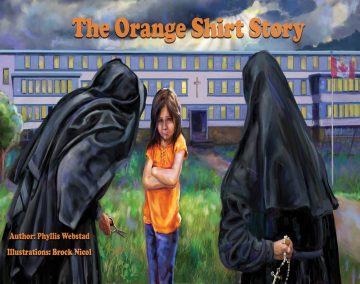
Phyllis Webstad is Northern Secwepemc from the Stswecem’c Xgat’tem First Nation (Canoe Creek Indian Band). She comes from mixed Secwepemc and Irish/French heritage, she was born in Dog Creek and lives in Williams Lake, BC. Today, Phyllis is married and has one son, a stepson and five grandchildren. She is the Executive Director of the Orange Shirt Society, and tours the country telling her story and raising awareness about the impacts of the residential school system. She has now published two books, the “Orange Shirt Story” and “Phyllis’s Orange Shirt” for younger children.
Why September 30th?
The date was chosen because it is the time of year in which children were taken from their homes to residential schools, and because it is an opportunity to set the stage for anti-racism and anti-bullying policies for the coming school year. It also gives teachers time to plan events that will include the true history of Canada and ensure that schools are teaching the Orange Shirt story to the next generations. The organization Orange Shirt Day has created digital resources and supplies to assist with understanding & planning of Orange Shirt Day, it also created digital teacher resources that can be embedded in daily lesson plans.
What can you do?
The orange shirt taken from one child is a symbol of the many losses experienced by thousands of students, and their families and communities, over several generations, including loss of language, culture, freedom, parenting, self-esteem and worth. It reminds us of the painful experiences of abuse and neglect that Indigenous children suffered. Orange Shirt Day is a day for survivors to be reaffirmed that they matter, and so do those who have been affected. Every Child Matters! Wearing an orange shirt is an affirmation of the commitment to raise awareness of the residential school experience and to reflect on our hope for a better future in which all children are empowered. The event was designed not only to commemorate the residential school experience, but also to witness and honour the healing journey of the survivors and their families, and to commit to the ongoing process of reconciliation. On September 30th, we wear orange! Join the Intergenerational March to commemorate Orange Shirt Day at UBC. The Faculties of Applied Science, Land and Food Systems and Forestry are honoured to host this annual event. Members of the UBC community, families and those in solidarity are welcome to participate. The March is intergenerational, and aims to be educational and supportive to the Indigenous community on campus and beyond. To find a wide range of Orange Shirt Day programming and information, explore the hub page curated by the Indian Residential School History and Dialogue Centre. There, you can access information about events, educational resources, and wellness support initiatives available at UBC Vancouver. The Centre also works with Indigenous artists to create a unique Orange Shirt Day t-shirt design. The last collaboration features the work of xʷməθkʷəy̓əm (Musqueam) artist təlnaq̕ə (Alec Guerin). In the following video, hear Alec speak about his art practice, creative influences, and the significance of the design.
Truth and Reconciliation Commission (TRC)
The Truth and Reconciliation Commission(TRC) provided those directly or indirectly affected by the legacy of the Indian Residential Schools system with an opportunity to share their stories and experiences. In order to redress the legacy of residential schools and advance the process of Canadian reconciliation, the Truth and Reconciliation Commission made 94 calls to action. In the following video, Ojibway judge, activist, Canadian Senator, and one of the Commissioners of the Canadian Truth and Reconciliation Committee, Justice Murray Sinclair, situates the Truth and Reconciliation Commission within the history of residential schooling. He reminds us about the residential school experience, why it should not be forgotten, and what is needed to help individuals learn from the experience and respectfully move forward from it.
Source: https://www.rcaanc-cirnac.gc.ca/eng/1450124405592/1529106060525
In the following video of Canada is … Hereditary Chief of the Gwawaenuk People Robert Joseph shares his experience as a residential school survivor and the importance of truth and reconciliation in Canada. Chief Robert Joseph was six years old when his mother dropped him off at St. Michael’s residential school in Alert Bay, B.C. — he spent 11 years there. Despite the government’s attempt at assimilation, he is one of the last few speakers of the Kwakwaka’wakw language. He has received many awards and honours and chaired and consulted with numerous organizations locally and internationally. Today he is the ambassador for Reconciliation Canada.
The Indian Residential School History and Dialogue Centre
The Indian Residential School History and Dialogue Centre (IRSHDC) at UBC addresses the colonial legacy of residential schools and other policies imposed by the Canadian government on Indigenous Peoples, and ensures that this history is acknowledged, examined and understood within the UBC community. The Centre works with partners across disciplines, at UBC and beyond, to facilitate dialogues and access to records and information that support engaging the legacies of the residential school system and the on-going impacts of colonialism in Canada. The records from the Centre offer diverse perspectives (former students, officials, journalists, scholars) and include Survivor testimonies, Truth and Reconciliation Commission hearings, photographs, maps, government documents, church documents, and newspaper articles. Responding to Survivors’ desire to have a single point of access to residential school records, the Centre provides access to an online database containing digital copies of records from partner organizations. This single access point brings together records that are otherwise dispersed online and in physical spaces. Once here you will have the opportunity to visit and learn more about IRSHDC.
The Indian Residential School History and Dialogue Centre has developed innovative technologies that support learning and listening. The exhibition space includes an interactive touchscreen wall that invites visitors to explore the history and ongoing legacy of the residential school system through multiple pathways. The interactive wall provides access to the Centre records and collections through the following features: timeline, map, browse and nodes. The interactive wall is a starting point for viewing the digital materials. It provides multiple perspectives on the residential school system. Explore the interactive touchscreen wall to find records, learn about residential schools and listen to voices from across the country as individuals share their stories.
Source: https://irshdc.ubc.ca/
Guest post by Indigenous Peer Mentor Daniel Gallardo Zamora (Ph.D. EDST), Sept. 2025